

The Announcement
The day Intel, AMD & Qualcomm all bled
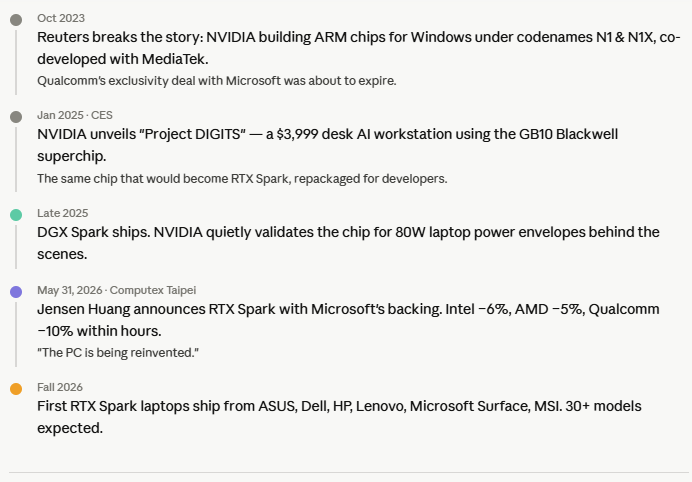
On May 31, 2026, Jensen Huang walked onto a stage in Taipei and quietly detonated a bomb under the PC industry. His company — which for 30 years has only made GPUs — had just built an entire processor for Windows laptops. One chip. CPU, GPU, NPU, memory controller. All fused together.
The markets reacted instantly: Intel –6%, AMD –5%, Qualcomm –10% in premarket trading. That’s the kind of number that doesn’t happen when a company just releases another graphics card. This was something different.
Jensen Huang said it best: “For forty years, you launched apps. Click. Type. With RTX Spark and Microsoft Windows, you ask, and the PC does the work.” That shift — from tool to teammate — is what this chip is engineered for.
The Architecture
One chip to rule them all — how it’s built
Traditional Windows laptops have a CPU from Intel or AMD talking to an NVIDIA GPU over a slow PCIe bus, each with its own separate memory pool. RTX Spark tears up that architecture and starts fresh.
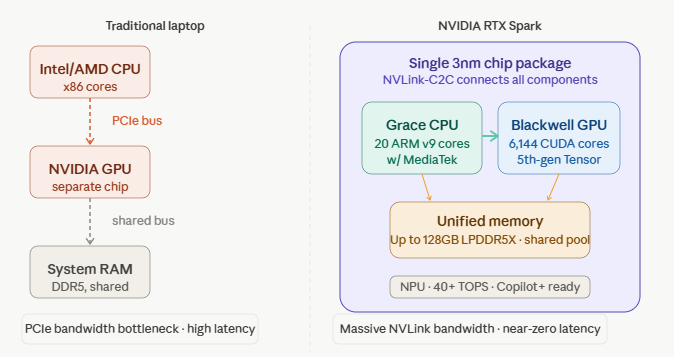
Why unified memory matters: When your CPU and GPU share the same memory pool, there’s no slow “copy data between chips” step. The GPU can instantly see what the CPU sees. For AI workloads, this is a game-changer — it’s why RTX Spark can run a 120-billion parameter model locally.
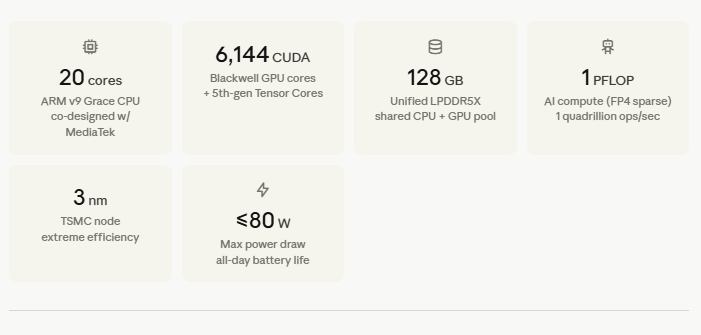
Specifications
Performance Benchmarks
How fast is it, really?
NVIDIA hasn’t released official benchmarks yet (laptops ship fall 2026), but we can make solid comparisons based on the GPU class parity they’ve claimed and known specs. Here’s how RTX Spark stacks up across three categories.
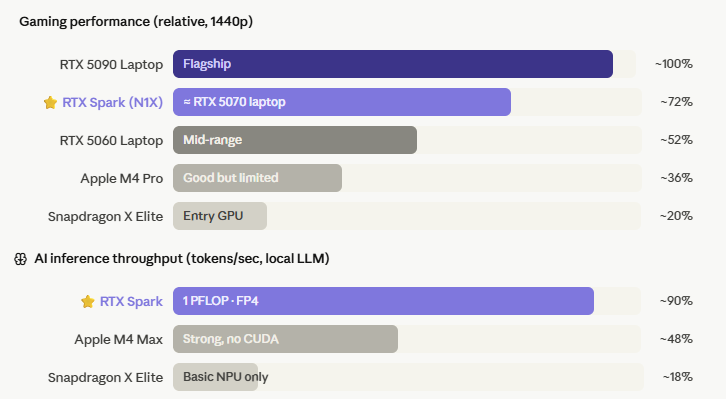
Note: These are relative estimates based on NVIDIA’s official GPU class parity claims and known architectural specs. Independent benchmarks from shipping laptops will be available in fall 2026.
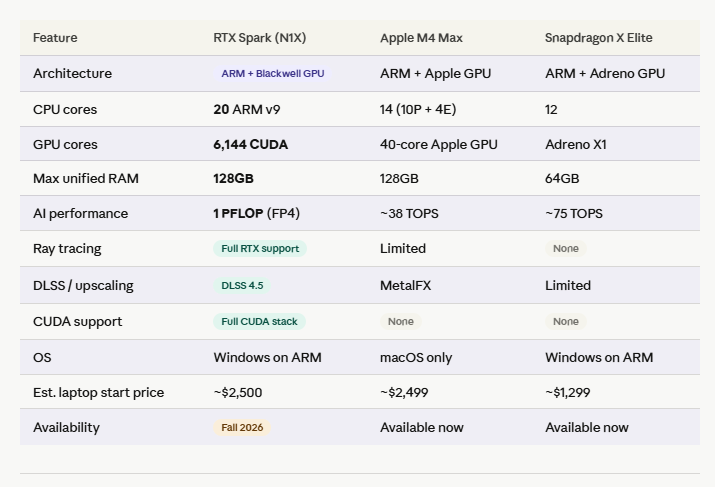
Comparison
The AI Story
Why 1 petaFLOP on your lap is wild
Here’s some context for that “1 PFLOP of AI performance” claim — because it sounds like marketing until you understand what it means.
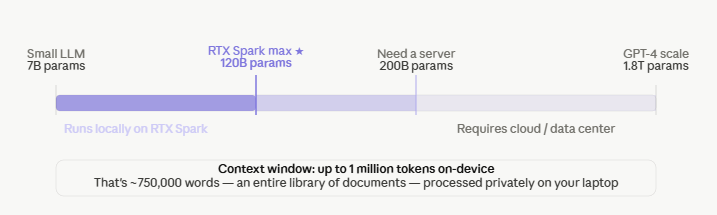
What this means for you: You could run a private, local version of an AI assistant as capable as GPT-4-class models — no internet required, no subscription, no data sent anywhere. Your files, your documents, your code — all processed on your machine.
Who is AI for
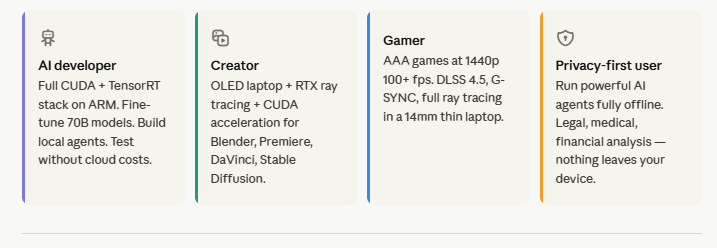
Four kinds of people who’ll love this
Devices
30 laptops, 10 desktops — who’s building them
NVIDIA says the initial wave will grow to 30 laptop SKUs and 10 desktop models by fall 2026. Here are the first announced devices.
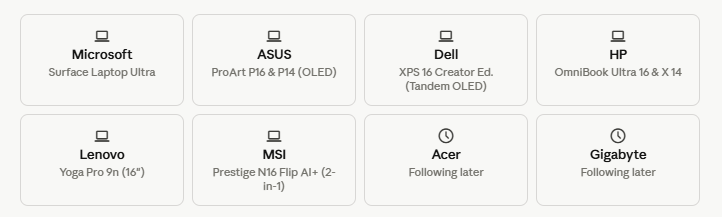
Desktop too: ASUS is also launching a compact RTX Spark mini-PC aimed squarely at the Mac Studio — a 150×150×51mm box with up to 128GB memory, 4× USB-C, HDMI, and 10Gb Ethernet. Same chip, more sustained power.
Pricing
Official prices aren’t confirmed, but industry sources and analysts have been talking. NVIDIA is targeting the premium segment first, with entry-level configs following.
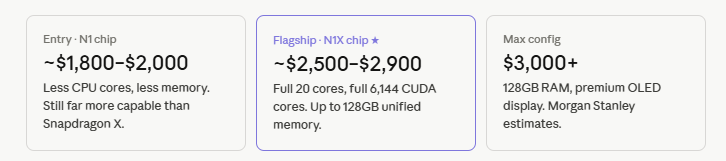
Worth it? MacBook Pro M4 Max starts at $2,499. RTX Spark at $2,500 gives you comparable AI performance, much stronger gaming, full CUDA support — but on Windows. If you’re in the Apple ecosystem, the switch cost is real. If you’re already on Windows, this is the most powerful thin-and-light you can buy.
The road to here
The Verdict
Should you be excited? Yes. Here’s the nuance.
RTX Spark is genuinely historic — the first time NVIDIA has built a full PC processor, and it enters with a bang. The specs are legitimately impressive: matching a dedicated RTX 5070 laptop GPU, running 120B AI models locally, doing it all in a 14mm chassis with all-day battery life. That’s not vaporware — it’s the same chip already shipping in the DGX Spark workstation.
The caveats are real though. $2,500+ is premium territory. Windows on ARM still has app compatibility quirks. Real-world sustained performance under thermal limits in thin laptops remains unverified. And benchmarks from shipping units don’t exist yet.
But directionally? This is what the next era of personal computing looks like: AI that runs locally, gaming performance in your bag, and a company that spent 30 years perfecting GPU silicon finally putting all of that into the whole computer.
Comments are closed