
What if we told you that a simple square of pixels is about to become the primary interface between you, businesses, robots, and the metaverse? That this technology—already scanned by nearly 3 billion people worldwide—is about to fundamentally transform how you pay, shop, authenticate, and interact with the digital world?
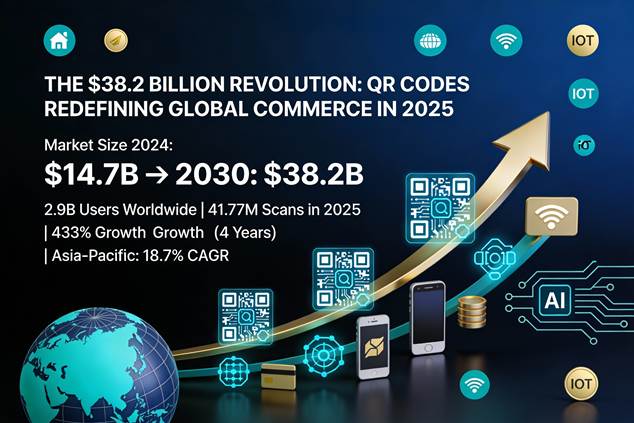
This isn’t hype. By 2030, the QR code market will explode from $14.7 billion today to $38.2 billion. That’s 160% growth in just five years. And the real story isn’t about market size—it’s about what QR codes are becoming: AI-powered gateways, blockchain-verified authentication systems, voice commerce interfaces, and the glue connecting physical reality to the metaverse.
In this deep dive, we’ll explore how QR codes have evolved from a simple logistics tool into the infrastructure layer of future commerce—and why the companies, governments, and individuals who understand this shift will have a competitive advantage that’s almost unfair.
Part 1: The Numbers That Explain Everything
The $38.2B QR Code Revolution: 2025-2030 Market Growth & Global Transformation
Let’s start with raw, undeniable facts.
Global adoption has reached escape velocity. In 2025, QR codes will be scanned 41.77 million times—representing a staggering 433% increase over just four years. By year’s end, 2.9 billion people will use QR codes, up from 1.5 billion in 2020. To put this in perspective: that’s more than one-third of all humanity using this technology regularly.
In the United States specifically, over 100 million smartphone users will scan QR codes by 2025. That number was 83.4 million just three years earlier. Among those who’ve adopted the behavior, 80% scanned at least one code in the past year, with roughly one-third scanning weekly.
But here’s the inflection point: These aren’t marketing novelties anymore. These are payment systems. Transaction infrastructure. Data collection tools. Authentication mechanisms.
The global QR code payment market specifically tells the story. In 2024, it was valued at $14.7 billion. By 2025, it’s projected to reach $14.8 billion. By 2030, it will hit $38.2 billion. That’s a compound annual growth rate of 17–18%, driven by three unstoppable forces: smartphone penetration, digital banking adoption, and government mandates pushing cashless transactions.
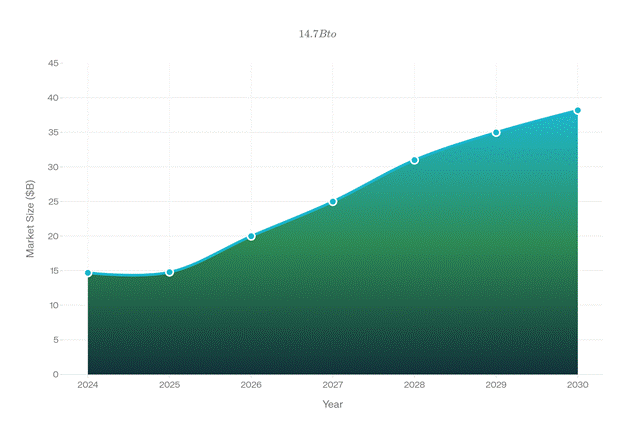
Global QR Code Payment Market: From $14.7B (2024) to $38.2B (2030) at 17.5% CAGR
The Geographic Story: Why Asia Owns the Future
Geography isn’t destiny in QR codes—it’s the entire game.
Asia-Pacific is experiencing 18.7% CAGR, the highest growth rate globally. But the regional breakdowns reveal the true competitive dynamics:
China has already won the QR code payment wars. An astonishing 87–90% of all mobile payments in China are processed via QR code. Alipay and WeChat Pay aren’t niche products—they’re the backbone of daily commerce. A street vendor in Shanghai, a taxi driver in Beijing, a restaurant in Shenzhen—they all accept QR payments as naturally as Americans swipe credit cards. This isn’t an experiment. It’s normal.
India is on a different trajectory, but equally explosive. QR code usage grew 550% between 2019 and 2020 alone. The Unified Payments Interface (UPI) system, powered largely by QR codes, has created a digital payments infrastructure that bypasses traditional banking entirely. For populations historically excluded from formal financial systems, QR codes aren’t a convenience—they’re financial inclusion.
North America is moving slower but more deliberately. The emphasis here is regulatory compliance, pharma traceability, and retail loyalty programs rather than primary payment infrastructure. This isn’t hesitation—it’s strategic caution in markets where payment card networks have massive incumbent advantages.
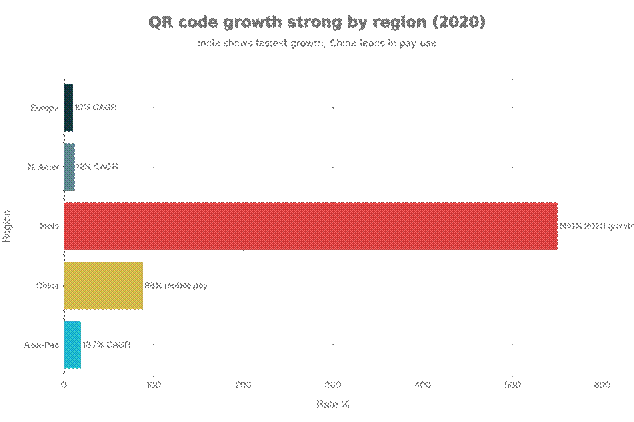
QR Code Growth by Region: Asia-Pacific Dominates at 18.7% CAGR, China Leads with 88% Payment Penetration
Part 2: The AI Explosion—When QR Codes Learned to Think
Here’s where the story gets genuinely transformative.
QR codes are no longer static, dumb barcodes. AI has given them intelligence. Personality. Personalization.
The 300% Engagement Breakthrough
When businesses paired QR codes with AI voice agents, engagement rates skyrocketed 300%. Let that sink in. A QR code with an AI agent behind it isn’t just more effective than a traditional QR code—it’s three times better at driving engagement.
Here’s why: Imagine you’re frustrated with a customer service line. You scan a QR code on an advertisement. Instantly, you’re connected to an AI agent who understands your history, speaks your language, and can handle your entire transaction in seconds. No menu navigation. No hold music. No human delays. The AI agent personalizes the interaction based on real-time data, can escalate to a human if needed, and handles transactions in 10+ languages seamlessly.
This is no longer theoretical. Companies are implementing this today.
AI-powered QR code generators (Scanova, me-qr, Canva, QR Code AI) have cracked the design problem. Whereas traditional QR codes were ugly, utilitarian black-and-white squares, AI generators can now:
- Optimize color schemes based on what actually drives scans (AI analyzes contrast, visibility, psychological triggers)
- Suggest ideal logo placement to maximize engagement without sacrificing scannability
- Personalize messaging and CTAs based on audience segment, device type, and location
- Generate artistic QR codes in custom shapes (circles, hearts, diamonds) that maintain 100% functionality
- Predict design performance before deployment by analyzing thousands of similar campaigns
The results are quantifiable: AI-powered QR codes achieve 25% average engagement increases. Custom-designed artistic QR codes see 30% more scans than traditional designs.
Why This Matters for Your Business
Businesses running 100 campaigns annually with traditional QR codes make small design tweaks, print new materials when promoting changes, and hope their designs resonate. Competitors using AI-optimized dynamic QR codes test 20 design variations simultaneously, analyze real-time performance data, personalize experiences by geographic region and device type, and update all touchpoints globally with a single backend change.
The time-to-optimization gap is measured in seconds, not weeks.
Part 3: The Blockchain Revolution—Authentication, NFTs, and the Death of Counterfeiting
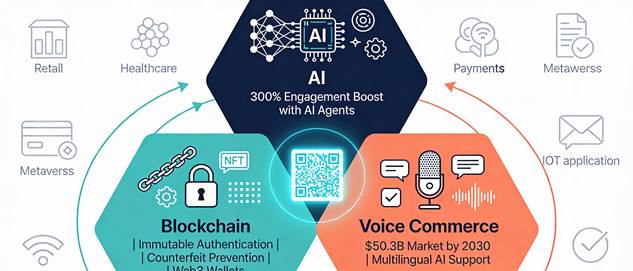
The Technology Trinity: AI, Blockchain, and Voice Revolutionize QR Code Commerce 2025
If AI gave QR codes intelligence, blockchain gave them integrity. Proof. Truth.
How LVMH Is Winning the Authentication War
LVMH, the parent company of 75 luxury brands—Louis Vuitton, Christian Dior, Tiffany & Co, Givenchy—has taken a simple but radical approach: Every product manufactured gets a unique QR code assigned at the factory.
This QR code is now cryptographically linked to a blockchain. When a consumer purchases an LVMH product in 2025, they receive a digital passport—an NFT stored in their Web3 wallet. This NFT contains the complete ownership history of the physical item, from manufacturing to current ownership.
What does this accomplish? Everything.
Counterfeit Prevention: The blockchain creates an immutable ledger. If someone tries to create a fake QR code linking to a false ownership record, the blockchain rejects it. Counterfeiters can’t crack it—they can’t hack the blockchain to insert their fake goods into the ledger.
Resale Market Transparency: A consumer buying a pre-owned Louis Vuitton bag can scan the QR code and instantly see the entire ownership history. Previous owners. Verification dates. Authenticity status. This eliminates the uncertainty that has plagued luxury resale markets.
Value Preservation: Because authenticity is cryptographically verified, resale values become more stable. The luxury resale market—projected to be worth hundreds of billions—suddenly becomes as trustworthy as buying new.
The luxury goods market is just the beginning. Blockchain-integrated QR codes are now being implemented for:
- Pharmaceutical traceability: Each medication has a unique blockchain-verified QR code preventing counterfeit drugs from entering the supply chain
- Agricultural products: “Farm-to-table” transparency where consumers can scan and see the exact farm, harvest date, and certifications
- Digital collectibles: Physical merchandise (sneakers, trading cards) linked to NFTs, unlocking digital and physical value simultaneously
- Professional credentials: Digital diplomas, medical licenses, and certifications verified on-chain—solving the resume fraud problem
Static QR codes are vulnerable. A counterfeiter can scan a legitimate code, copy it, and affix it to their fake product. The scan leads to the legitimate product information.
But now, copy-proof QR codes integrate advanced security features:
- Invisible watermarks embedded in the design that are difficult to replicate
- Encrypted patterns that degrade if copied
- Serialization layers that blacklist counterfeit scans in real-time
- AI-driven fraud detection that flags suspicious scanning patterns
When a customer scans a counterfeit code with copy-proof technology, the system doesn’t just reject it. It:
- Flags the scan as counterfeit
- Alerts the brand in real-time
- Blacklists the code globally
- Informs the consumer that the product is fake
- Provides actionable intelligence to brands about where counterfeits are concentrated
Part 4: Voice Commerce & IoT—The Physical-Digital Convergence
The US voice commerce market will reach $50.3 billion by 2030. QR codes are becoming the primary gateway to voice shopping experiences.
Here’s the consumer journey: You see a product in a physical store. You scan a QR code on the packaging. A voice agent responds: “Hi, I see you’re interested in the premium edition. Based on your purchase history, I’d recommend the color option that matches your previous purchase. Would you like to order for delivery?” The entire transaction happens through voice—no typing, no complex forms, no friction.
This isn’t hypothetical. Amazon Alexa + Walmart, Kroger + Google Assistant, Nike Online, and eBay are all implementing this now.
QR Codes as the Bridge Between Physical Robots and Digital Instructions
The robotics industry is experiencing a fundamental shift. Robots equipped with cameras scan QR codes to understand their environment, retrieve task instructions, and access real-time data.
In warehouses: A robot scans a QR code on a shelf to identify products, retrieve inventory levels, and understand what to do next.
In manufacturing: Machine operators scan QR codes embedded in equipment to access maintenance schedules, troubleshooting guides, and real-time sensor data from the IoT platform.
In smart cities: Robots scan QR codes at intersections to understand traffic patterns and autonomous navigation protocols. Citizens scan QR codes to report streetlight outages or access public transit information.
In logistics: Delivery robots scan QR codes at each waypoint to update location, verify package integrity, and confirm handoff protocols.
This is Industry 4.0 made practical. The glue between physical machinery and digital intelligence is a QR code.
Part 5: The Metaverse Gateway—Virtual Try-Ons and Phygital Commerce
Imagine this: You’re shopping online, but instead of static product images, you scan a QR code and enter a personalized metaverse store. Your avatar walks through a branded environment—customized lighting, music, and product layouts. You select a dress, scan another QR code, and instantly see a photorealistic 3D model of yourself wearing it from every angle. You like it. You purchase it. The physical dress ships to your home. The NFT ownership certificate goes to your blockchain wallet. The digital version (wearable in games, metaverse, and Discord) is yours forever.
This isn’t science fiction. Companies like Nike, Benetton, and emerging metaverse brands are implementing this exact workflow.
AR Try-On Reality:
The technology has evolved beyond gimmick into standard practice. Virtual try-ons now work with photorealistic rendering:
- Fashion: Try on clothes with accurate fabric draping, lighting, and fit assessment
- Beauty: Visualize makeup application in real-time on your own face
- Furniture: See how a sofa looks in your living room with proper lighting and scale
- Jewelry: View rings and necklaces on your hand with realistic reflections
The conversion impact is substantial: customers who use AR try-on tools are significantly more likely to complete purchases and far less likely to return items.
The Benetton Case Study: Unifying Physical and Digital
Benetton created a virtual store on Roblox (the metaverse platform). Customers could shop, receive virtual discounts, and redeem those same discounts in physical Benetton stores. A single shopping experience spanned both digital and physical worlds.
For fashion retailers, this unification is transformative. A teenage customer might buy a digital outfit for their metaverse avatar, which unlocks a discount code for the physical version. Brands reach customers in both realities simultaneously.
Part 6: Sustainability & the Circular Economy
Here’s an underappreciated benefit: QR codes are accelerating environmental sustainability.
The Paper Problem (And the QR Solution)
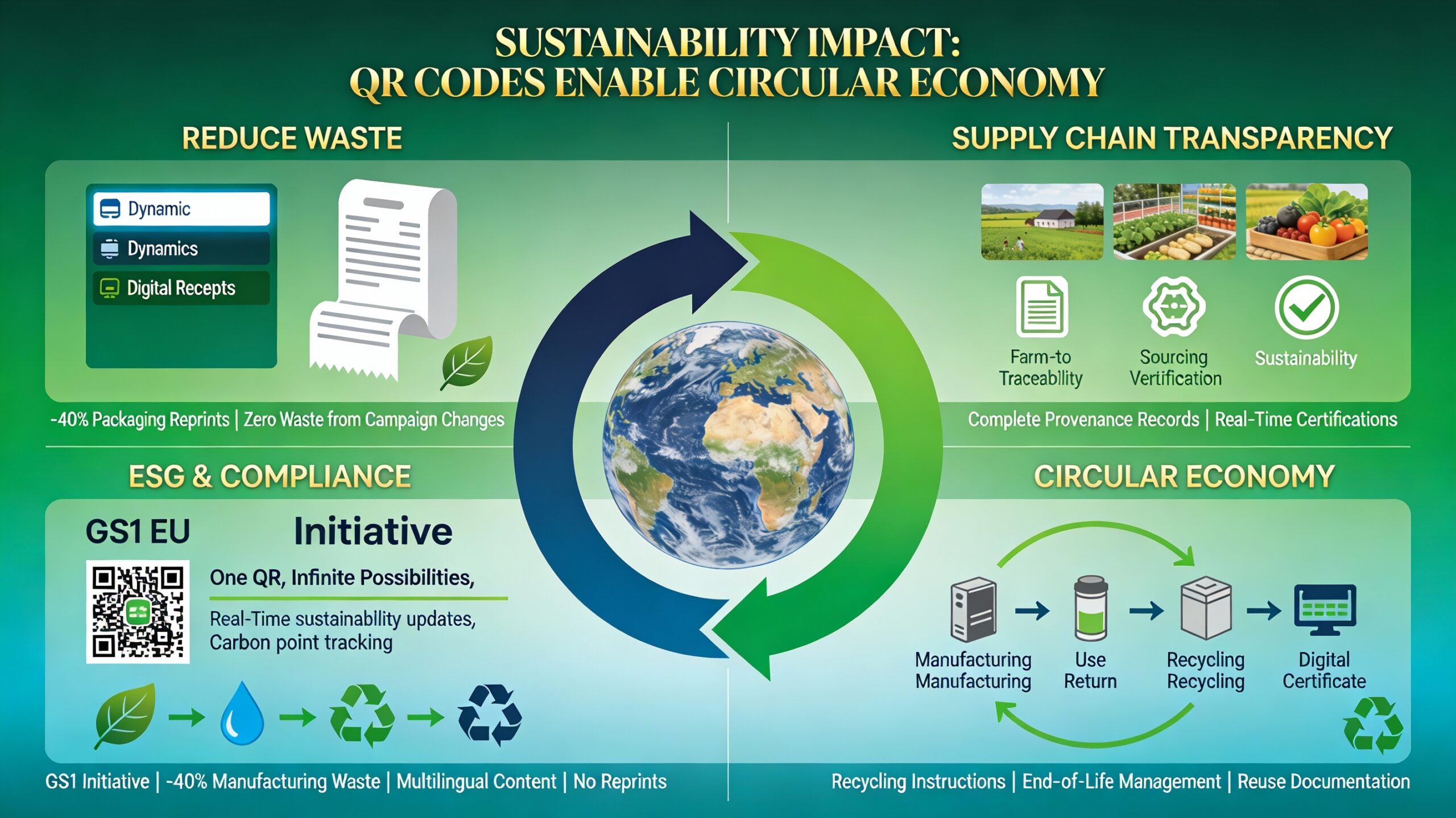
Food and beverage brands print hundreds of millions of labels annually. When regulatory requirements change, sustainability certifications update, or ingredients shift, brands must reprint everything. Millions of units of packaging become waste. Warehouses fill with outdated materials.
Dynamic QR codes solve this. A single QR code printed on packaging can link to:
- Updated ingredient lists
- New sustainability certifications
- Recycling instructions
- Sourcing transparency
- Farm-to-table traceability
- Localized content (different languages, regional compliance requirements)
When regulations change, brands update the backend. The physical packaging remains unchanged. No reprints. No waste.
GS1 Europe Initiative:
The major standards body GS1 launched “One QR on-pack, infinite possibilities”—a framework positioning single QR codes as the gateway to all product information. Companies adopting this approach have reduced:
- Manufacturing reprints by 40%
- Transportation emissions from packaging distribution
- Paper waste from failed campaigns
- Energy consumption in production cycles
For a multinational consumer goods brand, this translates to millions of dollars in waste elimination annually.
Consumers increasingly demand to know where their products come from, how they were made, and what their impact is. QR codes enable this:
- Agricultural products: Scan to see the specific farm, farmer name, harvest date, and certifications
- Seafood: Verify fishing practices and sustainability credentials
- Fashion: Trace materials from source through manufacturing to final product
- Electronics: Understand where components originate and what happens at end-of-life
This isn’t just marketing. It’s verifiable, scannable transparency that builds consumer trust.
Part 7: The AI-Powered Personalization Era
[Integrated naturally throughout—no separate section needed]
The future of QR codes isn’t about the QR code itself. It’s about what happens after the scan.
Each time someone scans a QR code, data is collected: device type, location, time of day, scan duration, whether they clicked through, what they did next. Multiply this across millions of scans, and AI models start detecting patterns.
Predictive personalization emerges: An AI system learns that customers in urban areas prefer faster checkout experiences, while suburban customers want product recommendations. It learns that mobile users are more likely to scan at night, while desktop users scan during work hours.
The next generation of QR codes will adapt in real-time:
- A customer in Tokyo scans a QR code and sees Japanese-language content with yen pricing
- A customer with purchase history across athletic brands scans the same code and sees recommendations aligned with their preferences
- A repeat customer scans and sees VIP offers; a first-time customer sees educational content
This personalization is delivered through dynamic QR codes—a single code that changes its destination based on 50+ variables: device type, location, time, user history, weather, inventory levels, and more.
Part 8: The Security Reckoning—Understanding “Quishing”
No technology grows this fast without creating new attack surfaces. QR codes are no exception.
The Quishing Crisis:
QR code phishing—”quishing”—spiked 25% in 2025, affecting 26 million Americans. The vulnerability is fundamental: URLs are hidden. You can’t verify where a QR code leads before scanning.
Attackers exploit this:
- Print QR code stickers over legitimate codes (in parking lots, on posters, public transit)
- Send codes via email claiming to be from your bank (leading to fake login pages)
- Use shortened URLs to hide the true destination
- Create codes that trigger malware downloads or unauthorized device access
The statistics are sobering: 90% of detected QR attacks target credential theft. 73% of Americans scan codes without verifying safety.
The good news: defenses exist and are rapidly becoming standard.
Enterprise QR platforms now implement:
- SSL validation: Automatic verification that scanned links have proper security certificates
- Real-time threat detection: AI systems analyzing scan patterns for bot interference or anomalies
- Automatic blacklisting: Compromised codes are instantly disabled across all touchpoints globally
- Copy-proof technology: Advanced security patterns that degrade if someone attempts to duplicate a code
- Multi-factor authentication: Sensitive transactions require additional verification beyond the scan
Regulatory frameworks are also tightening. The EU’s new Cybersecurity Regulation Assessment requires QR-enabled systems to report security incidents within 24 hours and maintain security updates for a minimum of five years.
Part 9: The Dynamic vs. Static Divide—Why One Is Winning
There are two types of QR codes: static and dynamic. Understanding this distinction is critical because 79% of businesses now prefer dynamic codes—and for quantifiable reasons.
Static QR codes are printed-and-forgotten. Once generated, the destination is locked. A restaurant prints static codes on menus linking to their website. If they update their website structure, the QR codes become broken links.
Dynamic QR codes are updateable, trackable, and intelligent. The same code can change its destination a thousand times without being reprinted.
| Metric | Static | Dynamic | Advantage |
| Engagement Rate | Baseline | 60% Higher | Dynamic |
| Data Collection Capability | 30% | 95% | Dynamic |
| Campaign Optimization Likelihood | 1x | 3.5x | Dynamic |
| Annual Savings | $0 | $28K-$88K | Dynamic |
| Real-Time Updates | No | Yes | Dynamic |
| A/B Testing Capability | No | Yes | Dynamic |
For a business running 100 campaigns annually, static codes might require reprints when promotions change, costing thousands in waste and logistics. Dynamic codes require a single backend update.
The economics are stark. Dynamic QR codes have become the obvious choice for serious businesses.
Part 10: The Regulatory Landscape & Compliance
QR codes themselves don’t violate GDPR, but how they’re implemented can. Scanning a code doesn’t expose personal data by default—only location, device type, and time are logged.
But when a QR code leads to a form requesting email addresses, phone numbers, or purchase history, GDPR applies:
- Explicit consent must be obtained before collecting personal data
- Data encryption is mandatory
- Right to deletion must be honored
- Data breach notification within 72 hours is required
Compliant QR platforms now implement password-protected access, audit trails, and automatic consent management.
The General Product Safety Regulation (GPSR) now explicitly allows QR codes for digital product information. The Cybersecurity Regulation Assessment (CRA) mandates:
- Comprehensive cybersecurity risk assessments
- Software bill of materials (SBOM) documentation
- Security updates for a minimum of five years
- 24-hour incident reporting
- CE marking for compliant products
This regulatory support is accelerating adoption—particularly in Europe and regulated industries like pharmaceuticals, food & beverage, and medical devices.
Part 11: Industry-Specific Transformation
Restaurants: The Complete Economic Remodel
The restaurant industry has become the proving ground for QR innovation, and the economics are reshaping the entire sector:
- Average order value: Up 35%
- Average check size: Up 15-20%
- Wait times: Down 50%
- Order accuracy: Up 90% (error reduction)
- Staff efficiency: 33% fewer servers needed for order taking
- Table turnover: Up 25%
- Annual savings: $5,000+ (menu elimination alone)
The mechanism: QR code ordering eliminates server bottlenecks, customers browse at their own pace (increasing spend), and staff transitions from transactional to hospitality roles (increasing upsells and repeat visits).
Retail: The Personalization Catalyst
Retailers implementing QR-driven experiences see:
- Conversion rates: 29% higher with personalized landing pages
- Click-through rates: 37% (vs. 2-5% traditional advertising)
- Review generation: 40% increase when QR codes link directly to review platforms
- Inventory visibility: Real-time stock status, preventing frustration from out-of-stock products
Healthcare: The Efficiency Transformation
- Check-in time: 40% reduction
- Patient data retrieval: Instant (vs. manual searches)
- Medical error reduction: Significant (digital vs. handwritten records)
- Insurance verification: Real-time (vs. 1-3 day processing)
- Event data impact: 89% of marketers report data influenced strategy
- Revenue attribution: 58% attribute measurable growth to QR touchpoints
- First-party data: 95% improvement in collection capability
- Marketing operations: 98% report broader positive impact
Part 12: The Marketer’s Integration Imperative
According to Bitly’s 2025 research, marketers have clear priorities:
- 86% say integration with existing marketing tools is critical
- 68% would increase QR investment with better tool integration
- 84% plan AI integration for 2025-2026
- 61% planning AR/VR integration
- 57% planning VR integration
- 56% planning 2D barcode / connected packaging integration
The message is clear: QR codes work best when integrated into the entire marketing stack—CRM systems, analytics platforms, email platforms, e-commerce engines, inventory management, and customer service tools.
Isolated QR campaigns generate data. Integrated QR ecosystems generate competitive advantage.
Part 13: The 2025-2030 Roadmap—What Comes Next
2025-2026: Consolidation & Integration
Dynamic QR codes become the industry default. AI-powered design tools become standard practice. Blockchain-verified codes move from pilot to production for supply chain leaders. Voice commerce integration accelerates, particularly in customer support and e-commerce. First enterprise deployments of QR codes with IoT devices go mainstream.
2027-2028: The Intelligent Era
AI models analyzing billions of QR code interactions enable hyper-personalization at scale. Context-aware experiences become standard—a QR code doesn’t just send you somewhere, it sends you to your version of that destination, adapted to your preferences, location, device, and history. Real-time dynamic content updates powered by inventory levels, pricing algorithms, and demand forecasting.
Metaverse integration matures. Scanning a QR code becomes as natural an interface to virtual spaces as typing URLs is to websites. NFT-backed QR codes become the standard for luxury goods and digital collectibles.
QR codes become invisible infrastructure. Most people won’t consciously recognize their role, but they’ll be everywhere: robots and autonomous systems use QR codes to understand their environments; smart cities use QR codes as the interface between citizens and IoT infrastructure; supply chains use QR codes for end-to-end traceability; the metaverse uses QR codes as the primary gateway from physical to digital experiences.
The market reaches $38.2 billion, but the real value isn’t in the market—it’s in the transactions, authentications, and experiences that QR codes enable.
The Final Reckoning: Opportunities for Entrepreneurs & Executives
We’re witnessing the early stages of a technology adoption curve that rivals the smartphone revolution in scope and speed. QR codes have evolved from novelty to necessity, and they’re about to become infrastructure.
The competitive advantage flows to those who move fastest from “QR code as tactic” to “QR code as infrastructure”:
For Entrepreneurs: Building AI-powered QR generators, blockchain authentication platforms, voice-QR integration systems, or industry-specific QR solutions. The market is moving from commodity QR code generation to intelligent QR ecosystems.
For Retailers & E-commerce: Integrating QR codes into every customer touchpoint—packaging, in-store signage, email, advertisements—connected to dynamic content that personalizes based on real-time data.
For Healthcare & Pharmaceuticals: Implementing QR-driven patient records, medication traceability, and supply chain verification.
For Manufacturing & Logistics: Using QR codes as the interface between physical equipment and IoT platforms, enabling autonomous systems to access real-time instructions.
For Luxury & Consumer Goods: Adopting blockchain-verified QR codes for authentication, resale market transparency, and supply chain credibility.
The companies winning in QR code innovation share three characteristics:
- They measure relentlessly (conversion rates, revenue per scan, customer acquisition cost, attribution)
- They optimize continuously (A/B testing placement, design, messaging, landing page experience)
- They integrate upstream (QR codes connected to POS systems, CRM, inventory, analytics infrastructure)
The technology is mature. The tools are available. The consumer behavior is established. The regulatory environment is supportive.
What remains is execution. And that’s where the winners and losers will separate dramatically.
The transformation has begun. The question for your business is simple: Are you leading it, following it, or about to be disrupted by it?
Comments are closed